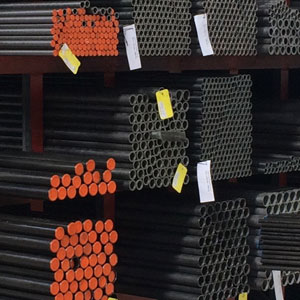
A pipe is a hollow, cylindrical industrial element used to transport fluids, gases, or solids, or for structural purposes. Steel tubes are indispensable raw materials in automotive, hydraulic, machinery, and defence industries due to their high pressure resistance, dimensional precision, and long service life.
Seamless tube is produced by piercing and rolling a solid steel billet. With no weld seam or joint, the internal structure is homogeneous. It shows superior resistance to high pressure and dynamic loads, making it the preferred choice for critical applications such as hydraulic cylinders, shock absorber bodies, and barrels.
Welded tube is produced by forming strip steel (sheet) and joining it by welding. Tubes produced by ERW (electric resistance welding) or HFI offer a cost advantage and are widely used in large-diameter applications.
Precision tubes under DIN 2391 and EN 10305 are primarily produced in carbon steel grades St 37-4, St 45, and St 52 (E235, E275, E355). For defence industry applications, 42CrMo4 (4140) alloy steel is used in barrel and hydraulic piston applications requiring high mechanical strength.
Precision steel tubes are used in automotive shock absorbers, steering systems, hydraulic cylinders, pneumatic circuits, construction machinery booms and jacks, agricultural machinery gearboxes, and defence industry barrel systems.
In industrial usage, 'pipe' is generally defined by outside diameter and wall thickness (DIN/EN standards), while 'tube' is defined by inside diameter. In precision steel tubes, both outside diameter and wall thickness tolerance classes are part of the order.
How is a tube measured in mm?
Precision steel tubes are specified by outside diameter (D) and wall thickness (t). For example, 30×3 denotes a tube with 30 mm OD and 3 mm wall thickness. Inside diameter = D – 2t.
What is the standard commercial length?
Precision steel tubes under DIN 2391 are typically delivered in 6 m commercial lengths. Cut-to-length within specific ranges is also available on request.
Is seamless tube always better?
Seamless tube is safer for high-pressure and dynamic load applications; however, welded tube serves low- and medium-pressure applications at a more competitive cost. The correct type should be selected according to application requirements.